
India’s position in the world in the next century is expected to be shaped by a combination of its growing economic power, demographic advantages, technological advancements, and geopolitical influence. Several key factors will determine its role:
Economic Growth
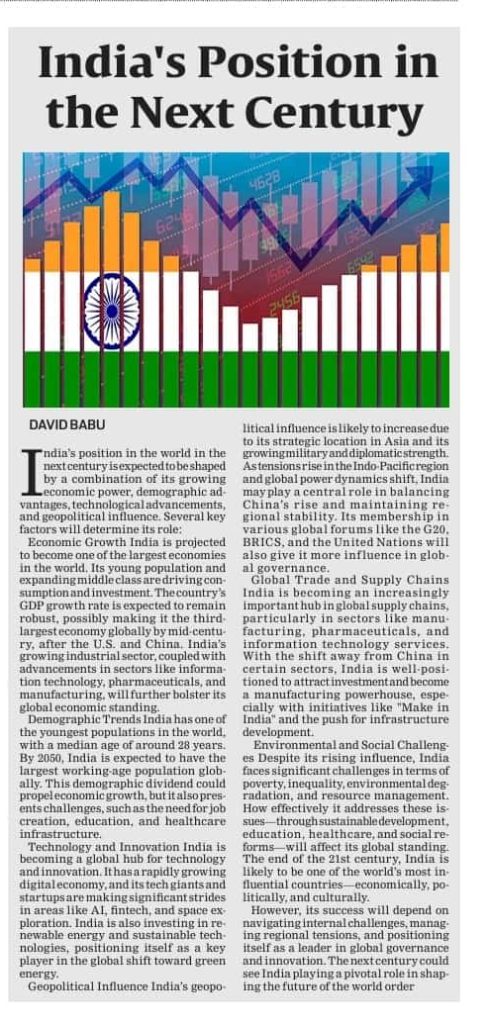
India is projected to become one of the largest economies in the world. Its young population and expanding middle class are driving consumption and investment. The country’s GDP growth rate is expected to remain robust, possibly making it the third-largest economy globally by mid-century, after the U.S. and China. India’s growing industrial sector, coupled with advancements in sectors like information technology, pharmaceuticals, and manufacturing, will further bolster its global economic standing.
Demographic Trends
India has one of the youngest populations in the world, with a median age of around 28 years. By 2050, India is expected to have the largest population globally. This demographic dividend could propel economic growth but will also present challenges, such as the need for job creation, education, and healthcare infrastructure.
Technology and Innovation
India is becoming a global hub for technology and innovation. Thanks to its fast-growing digital economy, thriving startup ecosystem, and advancements in areas like AI, fintech, and space exploration, India is likely to remain at the forefront of technological development. Its focus on digital public infrastructure and renewable energy will also shift toward green energy.
Geopolitical Influence
India’s geopolitical influence is likely to increase due to its strategic location in Asia and its growing military and diplomatic strength. As tensions rise in the Indo-Pacific region and global power dynamics shift, India may play a central role in balancing China’s rise and maintaining regional stability. Its membership in various global forums like the G20, BRICS, and the United Nations will also give it more influence in global governance.
Global Trade and Supply Chains
India is becoming an increasingly important destination for global supply chains, particularly in sectors like manufacturing, pharmaceuticals, and electronics.
With the shift away from China in recent years, India is well-positioned to attract investment and become a manufacturing powerhouse, especially with policy drives like “Make in India” and the push for infrastructure development.
Environment and Social Challenges
Despite rising influence, India will need to address environmental issues, including pollution, water scarcity, and climate change. Social challenges like poverty, inequality, and access to education and healthcare will also need continuous attention.
However, its success will depend on how effectively it manages internal development while playing a proactive role in the international arena. India is likely to remain a vital player in the global order, and its ability to adapt and lead will ensure its role in shaping the future of the world order.